Owner Builder FAQ
What is an owner builder?
An owner builder is a person who carries out the role of the builder in managing the construction of a residential home. These duties include budgeting, purchasing, project managing, employing tradesman and various building tasks.
Why become an owner builder?
Owner building can save the new home purchaser many thousands in reduced builders fees and tradesman's costs. It is also a great experience to build your own home. OB support ideas here...
How to be an owner builder?
There are differences from state to state, country to country, but generally two courses of education are required: the first is sometimes called a 'White card' which is a workplace health and safety certificate, and the second is a general building management certificate comprising project management, building processes, communication and task monitoring. These certificates are supplied to an authority, in Australia that is 'Fair Trading', to obtain a permit to act as an Owner Builder.
Pros and cons of being an Owner Builder
Taking on an owner-builder role changes the entire shape of a project. It shifts you from a “client” into the person who orchestrates the whole build. That shift brings real advantages, but also risks that need to be clearly understood before anyone walks down the DIY-construction path.The Pros
The benefits tend to be obvious once you look at how professional builders operate.
Full control of the build
As the owner-builder you decide the sequencing, the finishes, the materials and the workmanship standards. Nothing proceeds unless you’re satisfied. This level of control is appealing to anyone who wants their home built their way rather than to a builder’s preferred system or supplier network.
Freedom to choose trades
You pick the carpenter, the roofer, the plumber, the concreter — not the builder. This lets you avoid crews you don’t trust and reward tradespeople whose work you like. You can directly engage specialists known for quality rather than simply accepting whoever the builder assigns.
Ability to personally complete suitable work
An owner-builder can undertake non-specialist tasks such as painting, internal fit-offs, non-structural carpentry, general labouring, site prep and other unlicensed work. Every hour of work you contribute reduces labour costs.
Direct oversight of workmanship
Problems are caught early because you’re present. Instead of relying on periodic site visits or builder updates, you see the job unfold and can make course corrections immediately.
Control over timeframes
Some people want the freedom to pause the build when finances tighten, schedule holidays, or wait for better weather. An owner-builder can adjust timelines without contractual penalties.
Savings from eliminating builder margin
Most Australian builders apply a margin of roughly 20–35% on labour, materials, subcontractors and variations. Removing that margin can reduce the project cost significantly — provided the owner-builder manages the work efficiently and avoids expensive errors.The Cons
The downsides are less glamorous but very real. These are the areas where people run into trouble if they underestimate the responsibilities.
Risk of mistakes
Poor sequencing, incorrect installation and misunderstanding codes or engineering requirements can create expensive rework. A builder normally absorbs this risk; an owner-builder carries it personally.
Dealing with unreliable or rogue trades
Every industry has trades who cut corners, vanish mid-job or demand extra money. A professional builder typically filters these out through experience. An owner-builder must learn this the hard way unless they already have a trusted network.
Inaccurate estimating and budgeting
Professional builders estimate daily. Owner-builders often underestimate the true cost of materials, the labour time required, waste allowances, and the number of subcontractor visits. Overruns are common without rigorous cost control.
Longer build times
A professional builder manages overlapping trades, schedules deliveries precisely and keeps the site moving. Owner-builders often experience extended pauses while waiting for trades, organising inspections, or learning new tasks. Holding costs (rent, mortgage interest) can climb if delays stretch out.
Potential for lower quality
Quality slips when tasks are rushed, supervised poorly or performed by trades who aren’t specialists in the relevant area. Without strong technical knowledge, an owner-builder may not recognise substandard work until it’s too late.
Heavy project-management load
Coordinating trades, ordering materials, handling compliance, booking inspections, interpreting plans, and maintaining safety on site is demanding. A professional builder handles this daily; an owner-builder must learn on the fly and juggle everything with personal commitments.Balanced View
Being an owner-builder can save substantial money and offer unmatched control, but those advantages only materialise if the owner-builder commits to disciplined planning, careful supervision and realistic expectations. For people who enjoy organising projects and aren’t intimidated by responsibility, the role can be empowering. For those who prefer a predictable path with fewer risks, a traditional builder may be a better fit.
Is there Owner Builder Insurance?
There is no Builders Guarantee available in Australia for an OB, so if you sell it within 6 years, and there is a building fault, you are liable, unless you add a rider clause in your sales contract that the home is owner built, has no insurance, and the buyer assumes all responsibility. You definitely can get owner builder construction insurance, which covers OBs for material theft, storm damage, fire etc. General Public Liability is a must as well.
Can I get Owner Builder Construction Loans?
Yes, a new home construction loan is available just like normal house construction loans.
Can an owner builder do waterproofing, electrical, plumbing, roofing etc?
As an owner-builder in Australia you may do general building or renovation work yourself (e.g. framing, carpentry, non-specialist finishing), but you cannot legally do plumbing, electrical or waterproofing work unless you hold the appropriate licence. These areas are classified as “specialist trades” and must be carried out by licenced tradespeople. Roofing or general structural work may be feasible — but be clear that compliance with building codes, inspections and insurance requirements remains the owner-builder’s responsibility.
What sort of Owner Builder Construction can be personally done?
Plenty.
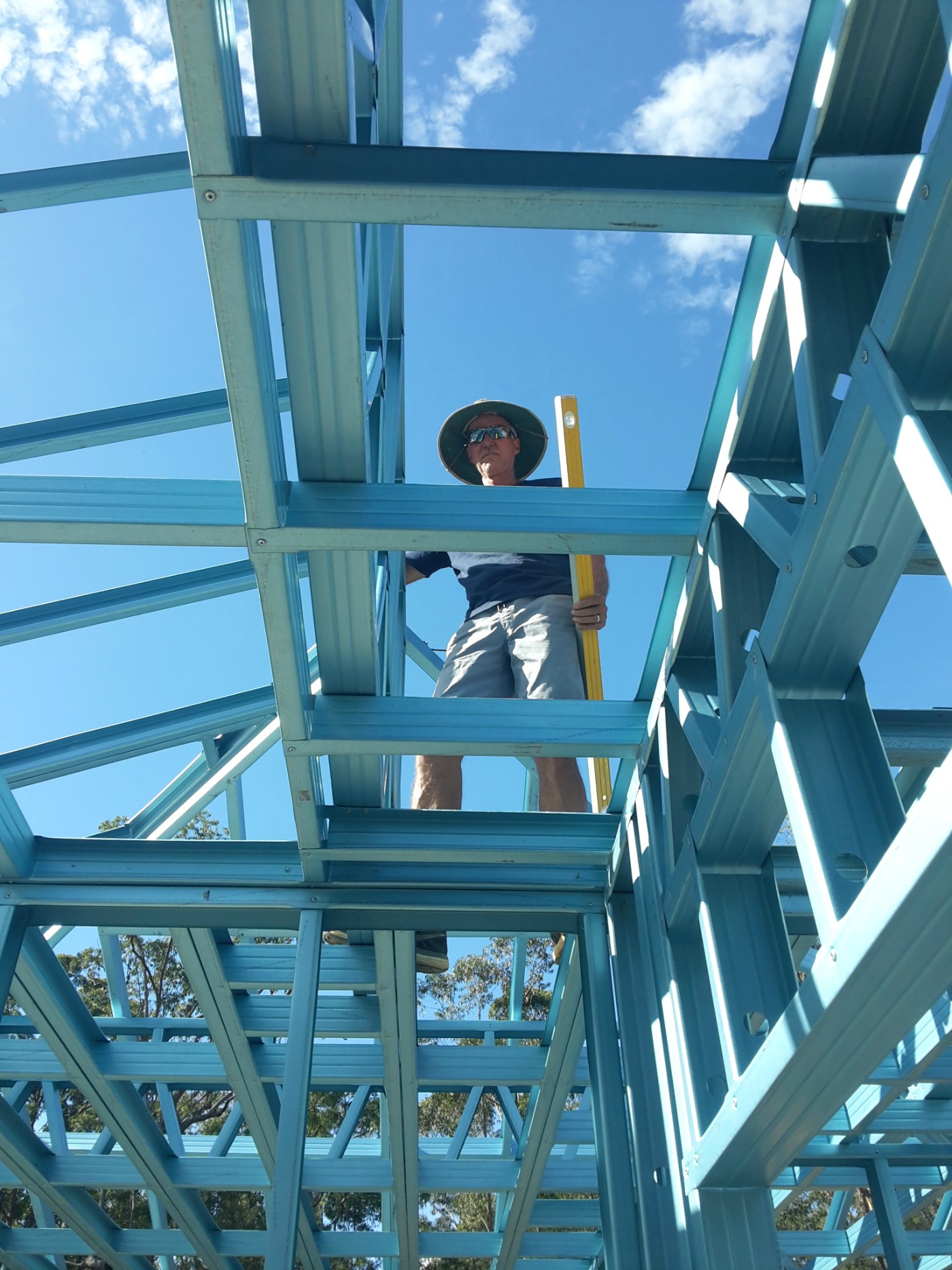
Standing prefab wall and roof frames, external wall cladding,
installing windows and pre-hung doors, architraving, skirtings, eaves,
verandah decks, flatpack kitchens, tiling, painting. All require
patience and skill, which all OBs have in abundance.
Is an Owner Built home able to be insured or sold?
Yes. Local
authorities will inspect an OB home as it is being built, just like a
builder built home and when finished, will be signed off as a registered
dwelling. Selling the home requires caveats in the contract regarding
the OB status and non-insured status if sold in under 6 years from the
finish date.
More owner builder pages on this site...
Kit home FAQs here, Kit home assembly here, DIY Housing here, Steps to building a house here
Go back to Home Building Plans or return to Kithomebasics home page